 Mohamed AchhibatNational Kitesurf Champion · IKO Instructor
"Essaouira or Dakhla?" is the question we get asked most often before a booking. The honest answer is that it depends entirely on what you are coming for — and there are cases where we will tell you to go to Dakhla.
The comparison in one table
| Essaouira | Dakhla | Tarifa | |
|---|---|---|---|
| Water | Open sea, chop and waves | Flat lagoon, ocean side too | Open sea, often choppy |
| Wind season | March to October | Late March to November | May to November |
| Typical wind | 15–25 knots | 15–25 knots, over 30 in summer | 10–25 knots, up to 40 in Levante |
| Consistency | Very good in summer | Excellent | The best of the three |
| Access | International airport, 2h30 from Marrakech | Domestic flight | Drive from Málaga or Gibraltar |
| Around the spot | UNESCO medina, restaurants, surf | Desert, kite camps | Busy seaside town |
| Best for | Learning, kite + surf, family trips | Freestyle, flat water, kite-only trips | Confident riders, guaranteed wind |
Dakhla: the lagoon
Dakhla is a shallow, perfectly flat lagoon, shielded from the ocean by a spit of sand. That is what makes it a spot apart: for learning on flat water or working on freestyle, nothing we have in Essaouira competes. You can fall a hundred times without a wave sending the board back at your legs.
The season runs from late March to November, peaking May to September — 15 to 25 knots daily, gusting past 30 knots in July and August. From January to March the wind eases to 12–18 knots, which is still perfectly good for learning.
The trade-off is isolation. Dakhla is far south and reached by domestic flight. Most people come on an organised trip, stay in a camp beside the lagoon, and kite. If you want to do anything other than kite, it is not the right place.
Essaouira: the wind and the town
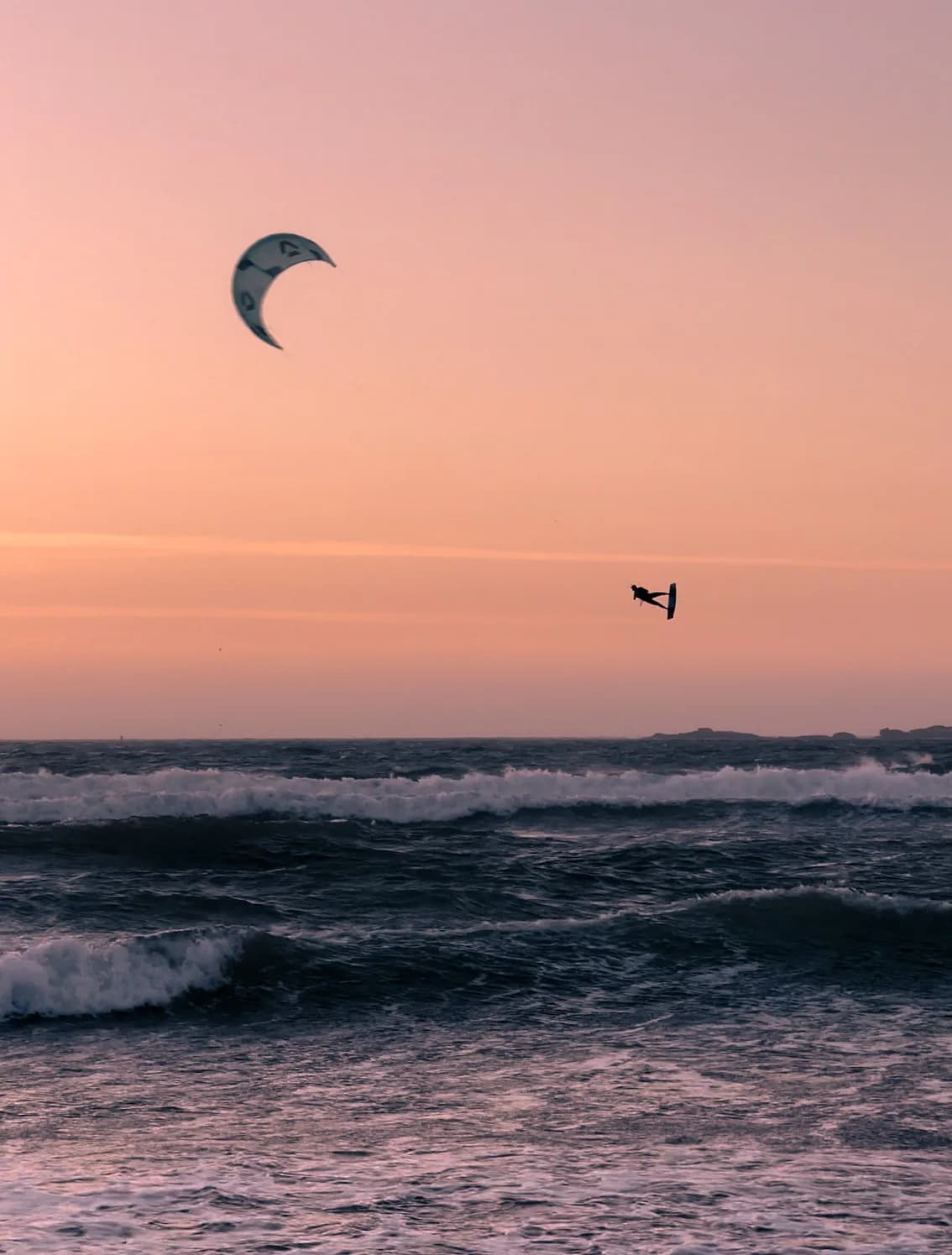
In Essaouira the north-east trade wind blows March to October, 15 to 25 knots, peaking in July and August. The water is open sea: chop, sometimes waves. Less comfortable than a lagoon for freestyle, but an excellent place to learn to ride in real conditions — the ones you will meet everywhere else.
What Essaouira has that the other two do not is everything that is not kiting. A UNESCO-listed medina ten minutes from the spot, surf breaks that take over when the wind drops, sandboarding in the dunes, and enough to occupy someone who does not kite. For a couple or a family where only one person rides, that difference is enormous.
Diabat beach has a shallow zone that makes learning far less intimidating than open water. We cover the conditions in our complete guide to kitesurfing in Essaouira and the month-by-month wind calendar.
Tarifa: the windiest in Europe
Tarifa, at the southern tip of Spain, claims over 300 windy days a year above 15 knots. Two regimes alternate: the Levante from the east, powerful and gusty, which can reach 40 knots, and the Poniente from the west, steadier and softer at 10 to 25 knots. The best window is May to November, and locals name April, May, June and October as the most pleasant months.
It is the most reliable of the three for wind. It is also the most expensive, and by far the busiest: in spring and summer the beaches are full and so is the water. If you are a beginner, the density of kites at Tarifa in August is a real factor.
So which should you pick?
You are starting out and want maximum comfort. Dakhla, for the flat water. Essaouira if you also want to sightsee, or if you are travelling with someone who does not kite.
You want to progress at freestyle. Dakhla, no argument. The lagoon is the difference.
You want guaranteed wind and you already ride independently. Tarifa, accepting the crowds and the budget.
You want to kite, surf, and do something other than sport. Essaouira. It is the only one of the three that ticks all three boxes.
You are coming with family. Essaouira, fairly clearly — it is a town people live in, not a kite camp or a saturated resort.
Can you combine Essaouira and Dakhla?
Yes, and it is what a lot of riders coming to Morocco for several weeks do: a few days in Essaouira for the town, the surf and sessions in the sea, then a domestic flight to Dakhla for the lagoon. The two spots do not really compete — they do different things.
If Essaouira is the one that fits you, we will take you out: our kitesurf lessons run from Diabat beach, all levels, recent gear. Message us on WhatsApp at +212 762-466351 and we will set dates around the forecast.